
Assistenzsysteme und Sensorik in Power-Tools - Testing
- Type:Bachelor-/ Masterarbeit
- Tutor:
- Links:Links_bearbeiten
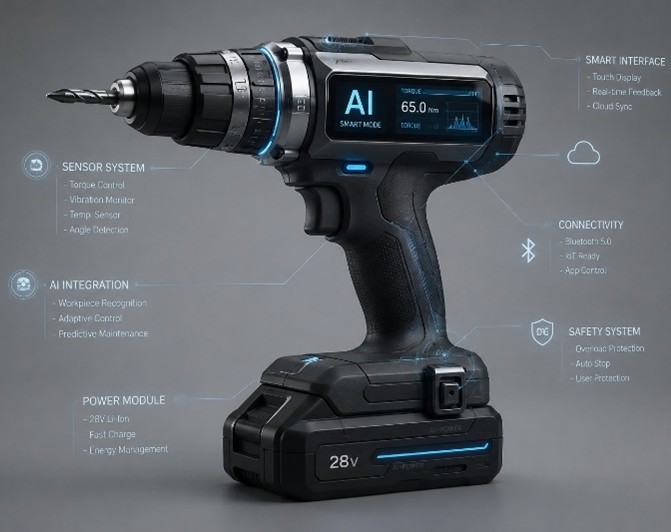
Modern power tools are increasingly equipped with integrated sensors and assistance systems (e.g., for torque control, kickback detection, or usage data collection). At IPEK, researchers are investigating how ergonomic parameters, such as joint angles and loads, can be derived from sensor data integrated into the tools. This work aims to establish an experimental foundation for this research and to examine the relationship between sensor signals from the tool and ergonomic characteristics.
Task:
As part of this project, a test environment will be set up to enable the synchronous acquisition of data from tool-integrated sensors (e.g., grip pressure, acceleration, motor current) and a reference measurement of body posture using optical motion capture (Vicon) during typical applications such as drilling and screwing. Based on this, experiments will be conducted and evaluated to identify correlations between the sensor signals and ergonomic movement and strain characteristics. Depending on the scope of the work, machine learning models will ultimately be developed to predict these characteristics from the tool data and evaluated for their predictive accuracy.
Profile:
- You are studying a degree program in mechanical engineering, mechatronics, or a similar field
- You have a structured, independent, and conscientious approach to work
- You have an interest in sensor technology, measurement technology, and/or ergonomics
- Basic knowledge in the sensor technology or data processing division is a plus, but not required
If you’re interested, I’d love to hear from you!