
History
The origins of the Institute for Product Development date back to the mid-19th century. In 1847, the Higher Technical School - one of five specialized schools within what was then known as the Karlsruhe Polytechnic - gave rise to both a school of chemical engineering and a school of mechanical engineering. Prof. Ferdinand Redtenbacher played a decisive role in this division and the resulting Faculty of Mechanical Engineering; he served as chairman of the mechanical-technical school and is regarded as the founder of modern scientific mechanical engineering. Prof. Ferdinand Redtenbacher’s successor in 1863 was Prof. Franz Grashof, who gained great recognition for his achievements in the Association of German Engineers (name of the German Association is VDI), among other things.
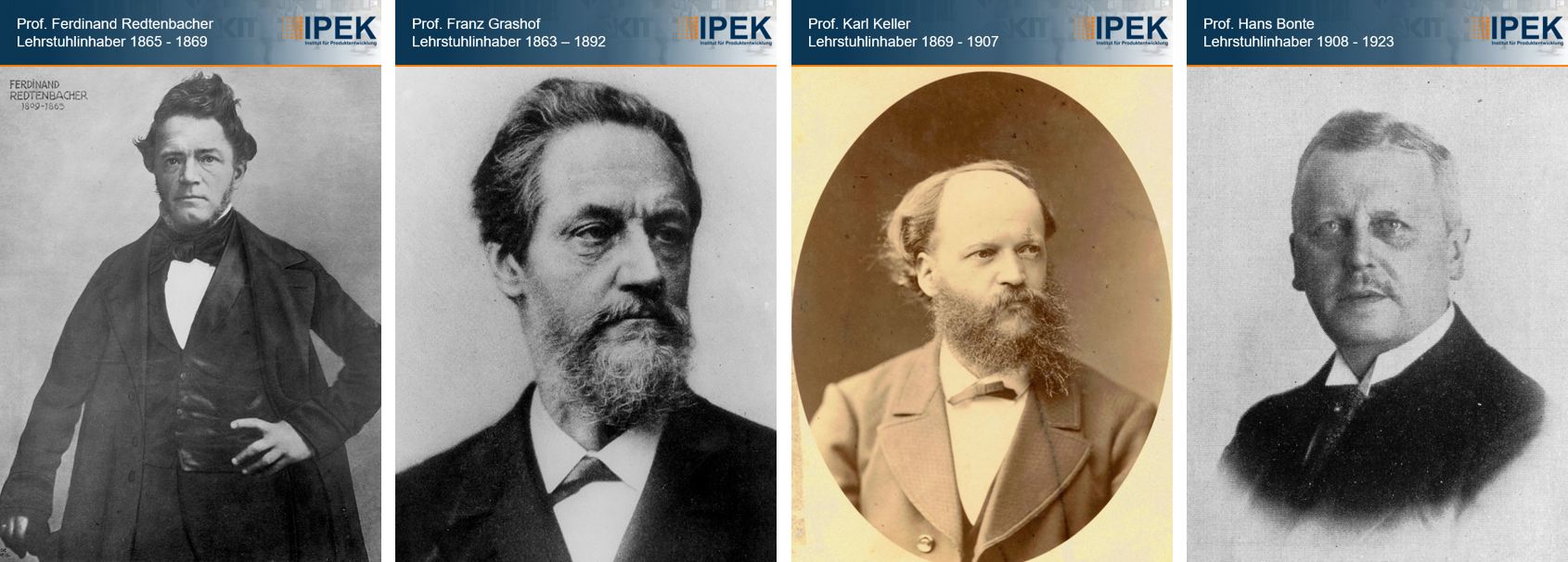
The appointment of Prof. Karl Keller as professor of the newly established “Machine Elements” chair in 1869 can be regarded as the origin of the Institute for Product Development. He taught courses on “hydraulic power machines,” “hoisting equipment” and the “Machine Elements” course previously taught by Ferdinand Redtenbacher. Prof. Karl Keller held the chair for 39 years until he was succeeded by Prof. Hans Bonte in 1908. Among other achievements during his tenure was the first doctoral dissertation in 1903 on the then-novel high-speed steam train capable of reaching 120 km/h. In 1924, Prof. Hans Kluge was appointed to the “Institute for Machine Elements and Motor Vehicles” and took over the chair from Prof. Hans Bonte. Under his leadership, the institute developed rapidly and received its first test benches specifically for motor vehicles in 1928. Due to the large amount of space required by the test benches and to enable continued close student supervision, an additional test room was made available to the institute.
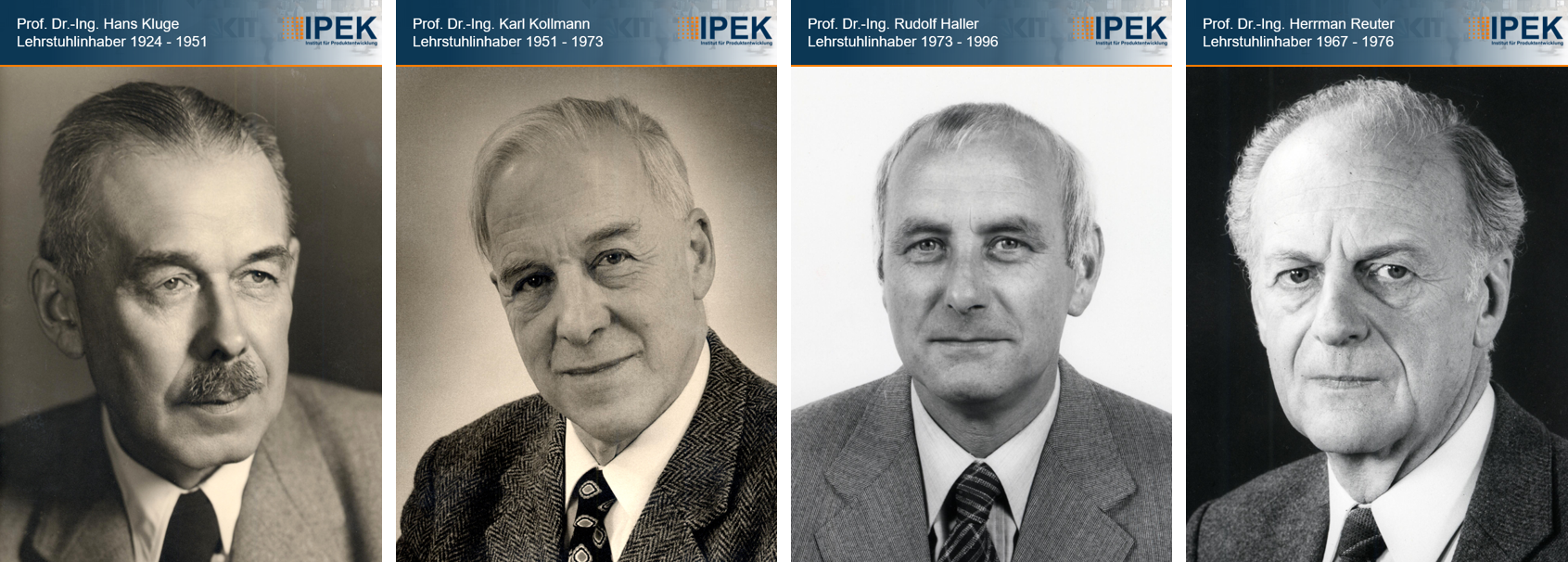
After the institute was rebuilt following its destruction in World War II, Prof. Karl Kollmann was appointed to the chair in 1952 and changed the institute’s name a year later to “Institute for Machine Design and Automotive Engineering,” and consequently also renamed the chair “Machine Design.” To accommodate the ever-growing number of students, a second chair titled “General Mechanical Engineering” was established in 1967 and filled by Prof. Herrman Reuter. Prof. Karl Kollmann was succeeded in 1973 by Prof. Rudolf Haller, who took over both the chair and the directorship of the institute. Prof. Herrman Reuter was succeeded from 1977 until his retirement in 1997 by Prof. Peter Kuhn. The chair in “General Mechanical Design” was not refilled as a result of cost-cutting measures under the Solidarity Pact.
From 1996 till 2026, Prof. Albert Albers took over as head of the institute and assumed the newly named Chair of Product Development and Drive Technology - formerly the Chair of Mechanical Design - from Prof. Rudolf Haller. In 2004, the institute was renamed IPEK - Institute for Product Development to align the name with its research priorities. To structure IPEK’s research activities in a sustainable manner, Prof. Albert Albers defined both the Karlsruhe School for Product Development (KaSPro), with its five basic hypotheses, and the Karlsruhe Teaching Model for Product Development (german shortcut: KaLeP).
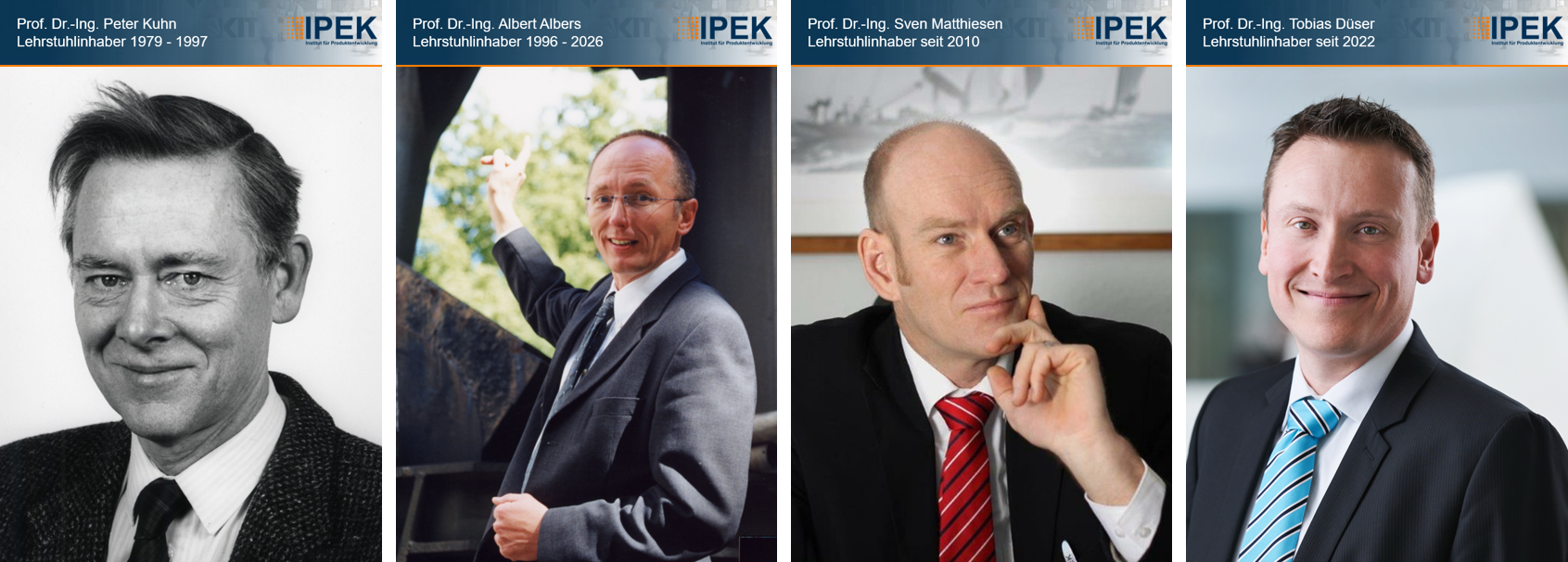
In 2010, Prof. Sven Matthiesen was appointed to the newly established Chair of Machine Design and Machine Elements. Prof. Matthiesen pioneered the field of human-machine systems and the scientific study of design and thought processes. In systems research, he focuses on mechatronic systems and machine elements. He integrates his research findings into new approaches to research-oriented teaching. In 2022, Prof. Tobias Düser was appointed to the Chair of Product Development and Propulsion Technology. In his research, Prof. Düser focuses on validation in product development. In addition, he works on advanced systems engineering methods as well as the use of artificial intelligence and metaverse-based approaches in system generation development. In addition to powertrain engineering, his systems-oriented research also encompasses connected and automated mobility as well as medical and health technology.