
Deep Learning for Generative Design of Sheet Metal Parts
- Subject:Generative Design, Deep Learning, Computational Design
- Type:Bachelor / Master Thesis
- Tutor:
Generative design enables the automated exploration of engineering design solutions. However, many existing approaches struggle to produce concepts that satisfy manufacturing constraints. Recent research has shown that integrating domain-specific knowledge into the generation process can significantly improve the manufacturability of generated designs.
At the institute, a rule-based generative design algorithm for sheet metal bending parts has been developed. This algorithm generates design concepts based on engineering rules and manufacturing constraints and serves as a structured framework for exploring the design space.
Deep learning methods offer the potential to learn generative strategies directly from data, enabling the exploration of larger and more complex design spaces. Combining data-driven methods with existing rule-based approaches may open new possibilities for generative engineering design.
Tasks
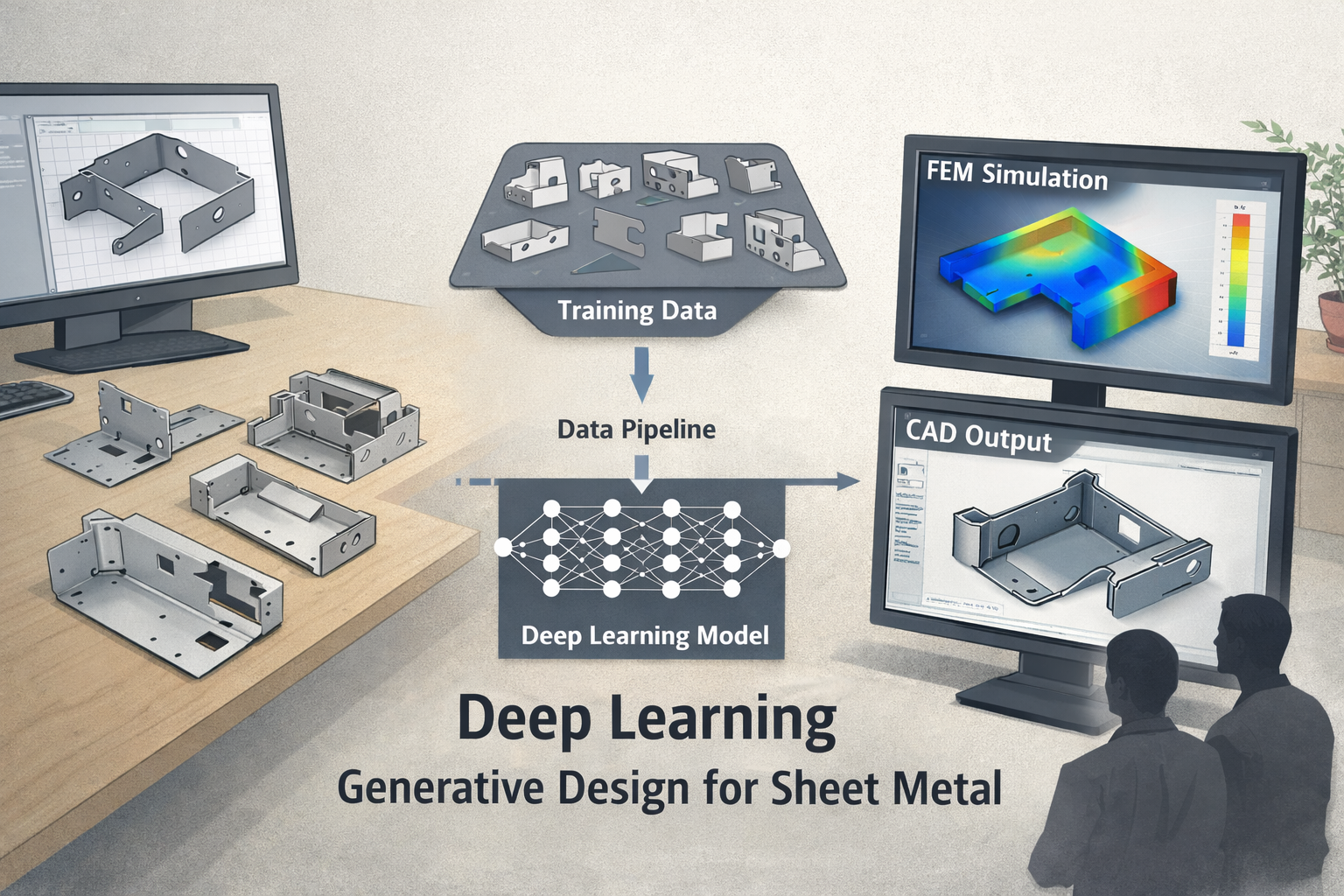
The goal of this thesis is to investigate deep learning as a generative method for sheet metal design and to develop the foundation for a data-driven generative design pipeline.
Possible tasks include:
-
Development of a data pipeline based on the existing generative design algorithm to generate and structure training data
-
Design and implementation of a deep learning architecture for generative design (e.g., graph-based or sequence-based models)
-
Definition of suitable representations for sheet metal structures for machine learning
-
Training and evaluation of the developed model on generated design datasets
-
Analysis of the potential and limitations of data-driven generative design for manufacturing-aware design
The exact scope and technical depth can be adapted depending on the student's background and interests.
Profile
-
Studies in Mechanical Engineering, Mechatronics, Computer Science, or a related field
-
Interest in machine learning, generative design, or computational engineering
-
Programming experience in Python
-
Experience with machine learning frameworks (e.g., PyTorch or TensorFlow) is beneficial
Bei Interesse melde dich gerne bei mir: christoph.wittig∂kit.edu